From Regulation to Implementation- Understanding Vehicle Cybersecurity legal Compliance & How Vehicle Cybersecurity Actually Gets Done
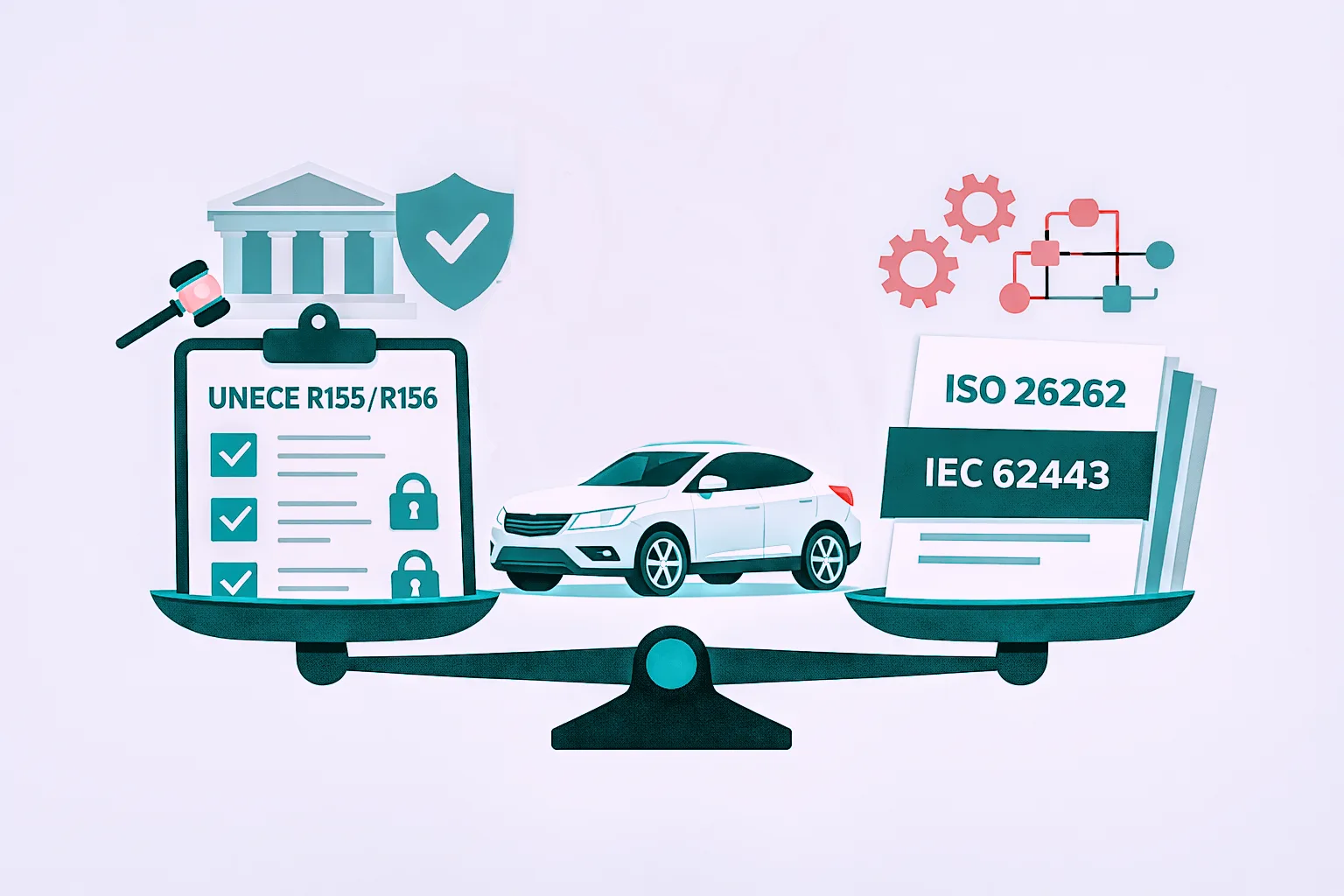
UNECE R155/R156 are regulatory requirements for vehicle cybersecurity and software updates, while ISO 26262 (functional safety) and IEC 62443 (industrial/IoT cybersecurity) are technical standards. The relationship is that UNECE mandates compliance at a regulatory level, and ISO/IEC standards provide the engineering frameworks and evidence manufacturers use to demonstrate compliance
- From Regulation to Implementation: Understanding Vehicle Cybersecurity Legal Compliance & How Vehicle Cybersecurity Actually Gets Done
- Real Incidents That Changed the Game
- Attack Vectors and Shared Risks
- Roles and Responsibilities
- Regulations vs. Standards
- Translating Compliance into Engineering
- Practical Implementation in the Industry
- Secure OTA Updates (R156 in Action)
- Additional Industry Details
- Key Considerations
- Getting Started for New Teams
- Mini Glossary
- Conclusion
- References
From Regulation to Implementation: Understanding Vehicle Cybersecurity Legal Compliance & How Vehicle Cybersecurity Actually Gets Done
Modern vehicles are complex systems with numerous software components from various suppliers, connected to the internet for over-the-air updates. This connectivity introduces significant cybersecurity risks, including potential accidents, data breaches, and operational disruptions.
This post explores the regulatory requirements for vehicle cybersecurity and software updates, focusing on how these regulations translate into practical implementation in the automotive industry.
Real Incidents That Changed the Game
Two major remote cyber attacks on vehicles that made headlines:
- Jeep Cherokee (2015): Remote control via infotainment connectivity led to a 1.4M vehicle recall and industry-wide hardening.
- BMW ConnectedDrive (2014): Cloud/app weaknesses enabled remote unlock; rapid patches followed. Source - Securityweek.com
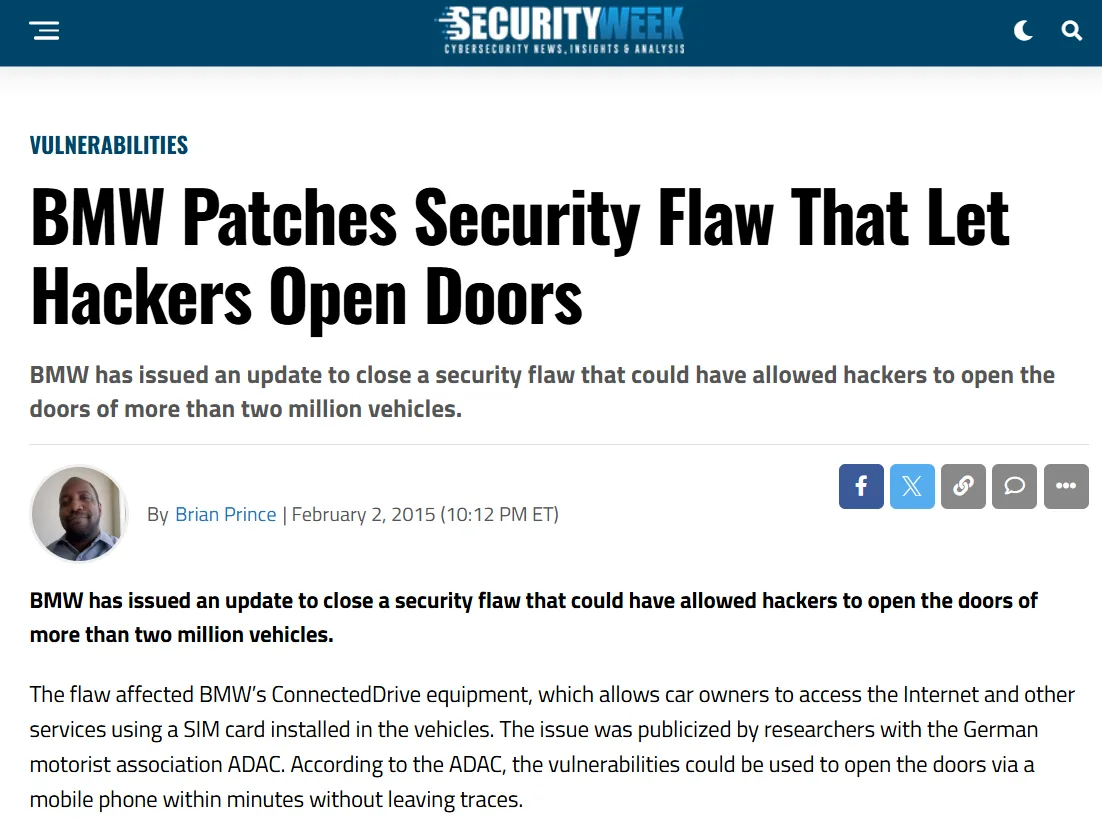
The fear from these incidents drove the industry to implement systematic controls, improved monitoring, and faster patching mechanisms.
Attack Vectors and Shared Risks
graph TD
    A[Internet / OTA] --> B[Telematics]
    C[Phone Apps] --> B
    D[USB / OBD] --> E[ECUs]
    F[V2X] --> G[Vehicle Network]
    H[Supplier Firmware] --> E
    B --> E
    G --> E[Electronic Control Units]
    E --> I[Brakes / Steering / Engine / Infotainment]
    style E fill:#ffcccc,stroke:#f66
Modern vehicles have numerous entry points for attackers. Without robust protections, attackers can move from peripheral systems to critical components. The objective is to mitigate these risks systematically and demonstrate compliance.
Roles and Responsibilities
- Regulators (UNECE): Establish legal requirements for vehicles in specific markets. For cybersecurity and updates, this includes UNECE R155 (CSMS) and R156 (SUMS).
- Standards Bodies (ISO/IEC): Provide detailed guidelines: ISO/SAE 21434 for automotive cybersecurity, IEC 62443 for industrial/IoT security, ISO 26262 for functional safety.
- OEMs (Car Makers): Own the product and final approval. They establish CSMS and SUMS, cascade requirements to suppliers, collect evidence, and obtain certification.
- Tier-1/2 Suppliers: Develop ECUs, firmware, and components that meet requirements; they provide test results and security documentation.
- Auditors / Technical Services: Verify processes, documentation, and vehicles against regulations and standards.
- Homologation Authorities: Approve vehicles for market sale.
Regulations vs. Standards
- UNECE R155 (Cybersecurity): Requires a company-wide CSMS covering risk assessment, secure development, supplier management, incident response, and continuous improvement throughout the vehicle’s lifecycle.
- UNECE R156 (Software Updates): Mandates a SUMS for secure update creation, delivery, verification, installation, and reporting.
- ISO/SAE 21434: The auto cybersecurity guide for putting CSMS/SUMS into action.
- IEC 62443: Patterns for securing networks and components, useful for vehicles and backends.
- ISO 26262: Functional safety; links hazards and risk levels (ASIL) to development strictness and testing.
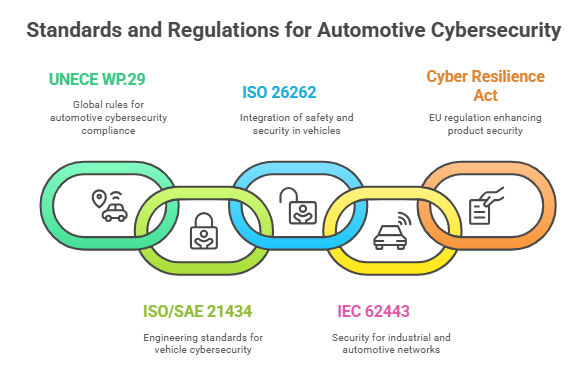
Context: This visual helps connect the regulatory “what” (UNECE WP.29/R155/R156) with the engineering “how” (ISO/SAE 21434, IEC 62443) and safety linkage (ISO 26262). Source: upGrad — https://www.upgrad.com/blog/automotive-cybersecurity/
| Area | Regulation (What) | Standards (How) |
|---|---|---|
| Organizational security | UNECE R155 | ISO/SAE 21434 + IEC 62443 |
| Software updates | UNECE R156 | ISO/SAE 21434 + IEC 62443 |
| Safety integration | — | ISO 26262 (link cyber impacts to safety) |
Translating Compliance into Engineering
graph LR
    A[UNECE R155/R156<br/>Legal Requirement] -->|Mandates| B[CSMS & SUMS]
    B -->|Implemented with| C[ISO/SAE 21434]
    C --> D[Controls from IEC 62443]
    B --> E[Safety Link via ISO 26262]
    E --> F[ASIL-driven V&V]
    style A fill:#ffcccc
    style C fill:#e6ffe6
    style D fill:#d1e7ff
    style E fill:#fff3cd

Context: The V-model shows how new vulnerabilities or software updates trigger re-design and re-verify cycles across concept, design, and validation. Source: SemiEngineering — Curbing Automotive Cybersecurity Attacks (Keysight Technologies).
A typical project follows this flow:
- Business intent → Scope: Select models, markets, and features; determine applicable regulations.
- Establish CSMS/SUMS: Define policies, roles, checkpoints, and training; select tools for threat modeling, vulnerability management, and evidence tracking.
- TARA (Threat Analysis and Risk Assessment): Identify assets, threats, and risks; prioritize mitigations.
- Requirements cascade: Communicate security requirements to systems, ECUs, and suppliers with measurable criteria.
- Architecture & controls: Implement patterns (secure boot, cryptographic keys, secure communications, domain isolation) based on ISO/SAE 21434 and IEC 62443.
- Safety integration: Where cybersecurity impacts safety, integrate with ISO 26262 hazards and ASIL levels for enhanced rigor.
- Verification & validation: Perform static analysis, fuzzing, penetration testing, and integration testing; manage bug fixes.
- Evidence collection: Compile process logs, test reports, update procedures, incident response plans, and monitoring data.

Context: Analytics and data collection accelerate evidence creation, highlighting gaps to address before type approval. Source: SemiEngineering — Curbing Automotive Cybersecurity Attacks (Siemens).
- Approval & release: Conduct audits and obtain type approval; proceed with controlled OTA deployments.
- Operations: Monitor fleets, manage vulnerabilities (via PSIRT), and sustain SUMS for secure updates.
Practical Implementation in the Industry
In automotive cybersecurity, teams manage processes governed by CSMS and SUMS requirements. Development projects progress through phases from concept to production, with security assessments at each stage. Early issue detection is crucial, as later fixes can cost 10-100 times more. Failure to address issues may result in expensive redesigns or certification failures.
OEMs communicate security requirements to suppliers, including threat models, key management, update mechanisms, and testing coverage. Suppliers develop 70% of vehicle software, making robust oversight essential to prevent vulnerabilities that could lead to recalls or legal issues.
PSIRT teams manage vulnerabilities and incidents: they triage reports, develop patches, and deploy updates. Rapid exploitation of vulnerabilities necessitates swift responses. Without a PSIRT, patch deployment lags, giving attackers an advantage.
New vulnerabilities or updates require re-testing to prevent regressions. Updates can introduce failures or new security weaknesses. Inadequate testing risks vehicle bricking or compromised security.
Regular audits and certifications are mandatory; documentation is retained for years. This is essential for market access. Lack of certification prevents sales.
Overall, the focus is on informed, evidence-based decisions to reduce risks—not absolute security, but continuous improvement.
Sources: SemiEngineering (Synopsys, Siemens, Keysight); ISO/SAE 21434; UNECE R155.
Secure OTA Updates (R156 in Action)
sequenceDiagram
    participant OEM
    participant Vehicle
    participant Attacker
    OEM->>OEM: Build & sign update
    OEM->>Vehicle: Deliver via secure channel
    Vehicle->>Vehicle: Verify signature & integrity
    Vehicle->>Vehicle: Check compatibility & safety
    alt Valid
        Vehicle->>Vehicle: Install & activate
        Vehicle->>OEM: Report success
    else Tampered/invalid
        Vehicle->>Vehicle: Reject & log
        Attacker--xVehicle: Block fake update
    end
Updates are handled as major releases: cryptographically signed, deployed in phases, with backups and post-installation verification.
Additional Industry Details
- Attack patterns: Remote hacks outnumber physical ones; many hit backend servers for connected cars. Attacks have jumped over 200% lately. Source: SemiEngineering citing AI EdgeLabs.
- WP.29 and local law: UNECE WP.29 sets binding rules that countries turn into local laws; compliance is needed for approval in those spots. Source: SemiEngineering.
- R155 compliance certificate: OEMs get CSMS certs from authorities. Valid for years, refreshed on big changes; keep docs long-term. Source: SemiEngineering.
- R156 specifics: SUMS must be documented, checkable, and secure, with IDs to track ECU software. Source: SemiEngineering.
- Re-test after change: New exploits or updates mean re-checking the V-model’s validation side, best if automated for speed. Source: SemiEngineering.
- Practical controls: Examples include secure boot, hardware trust roots, strong keys, encrypted links, intrusion detection, address randomization, and access controls. Source: SemiEngineering.
- Measurable mitigations: R155 lists threat types for vehicles, supply chains, and backends; teams map them to CSMS controls and proof. Source: SemiEngineering.
- Measures overview: Guides highlight OTA security, segmentation, IDS, and DevSecOps as key for modern fleets. Source: upGrad.
Key Considerations
- Compliance vs. security: Audits are mandatory, but effective protection requires robust design and rapid response capabilities.
- Trade-offs: Constraints in speed, cost, supplier capabilities, and legacy technology prevent ideal implementations.
- Evidence as documentation: Unrecorded actions are invalid. Establish processes that automatically generate evidence.
- Backend importance: Vehicle security depends on the strength of cloud and backend connections.
- OTA capabilities: Over-the-air updates enable rapid fixes but also present significant attack surfaces if not properly secured.
Getting Started for New Teams
- Conduct TARA: Identify assets, threats, and risks; prioritize the top five.
- Select controls: Implement secure boot, cryptographic keys, encrypted communications, system hardening, and logging.
- Establish PSIRT: Define processes for vulnerability intake, triage, patching, and disclosure.
- Implement SUMS: Set up signing, delivery, installation verification, and reporting mechanisms.
- Ensure continuous evidence collection: Automate traceability from requirements to testing.
Mini Glossary
- CSMS: Cyber Security Management System.
- SUMS: Software Update Management System - System for secure software updates across the fleet.
- TARA: Threat Analysis and Risk Assessment.
- ASIL: Automotive Safety Integrity Level (ISO 26262 risk scale).
Conclusion
UNECE R155/R156 define the mandatory requirements. ISO/SAE 21434, IEC 62443, and ISO 26262 provide the frameworks for implementation. OEMs and suppliers integrate these into their designs, testing, and—crucially—evidence generation. For those new to this field, begin with a TARA, select appropriate controls, and establish update and incident response processes that naturally produce required evidence. This is how secure vehicles are developed and maintained.
References
- SemiEngineering — Curbing Automotive Cybersecurity Attacks: https://semiengineering.com/curbing-automotive-cybersecurity-attacks/
- upGrad — 18 Key Automotive Cyber Security & Vehicle Cybersecurity Measures for 2025: https://www.upgrad.com/blog/automotive-cybersecurity/